Questions
Before you begin
Everything readers usually ask about the book, the editions and the games.
 By Tejash Shah · Amazon bestselling author of 10 books
Questions
Before you begin
Is this book about destiny or freewill, or does it take a side?
It does not take sides. It explores how destiny and freewill coexist: some things in life are given, others are shaped by our choices, and understanding the difference brings clarity.
Do I need a spiritual or philosophical background to read it?
Not at all. The book avoids heavy philosophy and jargon. It uses a simple conversation and everyday examples like rain, traffic, a fever and a job loss, so anyone can follow it.
Is this book religious?
No. It draws on Indian wisdom, including the Bhagavad Gita, the Upanishads, Osho and Vipassana, but it does not promote any religion or belief system. The focus is understanding life, not following doctrine.
How is karma explained: as reward and punishment?
As cause and effect, not reward or punishment. Destiny gives the situation, you respond with freewill, your response creates a result, and that result becomes your next destiny.
Why is the book written as a conversation?
Because real understanding often comes through dialogue, not instruction. Two friends talk over chai, one asking the questions most of us carry silently and one answering with patience and humour. It mirrors how we question life inside our own heads.
Who are the two characters?
They have no names on purpose. The Questioner is the human mind: curious, restless and funny. The Guide is the observing mind: calm, practical and never preachy. They could be anyone, which is the point.
Does the book say everything is already decided?
No. It explains where destiny ends and freewill begins: destiny is what cannot be changed, and anything that can be changed is freewill. Confusing the two creates unnecessary suffering.
Does it offer answers or raise more questions?
Both, on purpose. Some questions find clarity; others are left for you to reflect on. The goal is not to give fixed answers but to help you think clearly.
Is the book based on real-life experiences?
In essence, yes. It is not an autobiography, but the insights come from observation, lived experience, years of reflection and the author’s own practice of Vipassana meditation.
Will this book help me make better decisions?
It will not tell you what to decide. It helps you understand how decisions work and why awareness matters more than control.
Is this a motivational book?
No. It does not push motivation or success formulas. It offers understanding, which often leads naturally to calm, clarity and better action.
Can it help during difficult phases of life?
Many readers find it especially relevant during confusion, loss or uncertainty. It does not promise solutions, but it helps you see difficult phases with perspective. Pain is destiny; suffering is freewill.
Is it meant to be read once or revisited?
It can be read in one sitting, but many readers return to certain chapters. The simplicity lets deeper meanings emerge over time.
What makes it different from other books on destiny and free will?
Most books choose one side or become theoretical. Destiny vs FreeWill focuses on balance, practicality and lived understanding, and it keeps a light, humorous tone throughout.
Is it available in Gujarati?
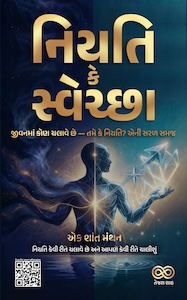
Yes. The book is available in English and Gujarati. The English edition comes as an eBook, paperback and hardcover; the Gujarati edition as an eBook. In India you can also order a printed copy on WhatsApp.
Is it suitable for all age groups?
Yes. The language is simple and respectful. Anyone interested in understanding life and choices can read it.
Are the games on this website free?
Yes. All four games are free and work in your browser with no app or sign-up. After a game you can leave your name and email to receive your result, or simply skip.
Get your copy
In English and Gujarati
Printed copy in India
Ships across India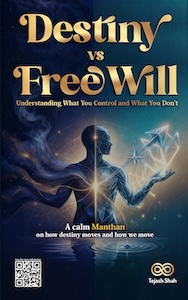
- 1Pay ₹464 by GPay to 9820562897
- 2Send your delivery address and edition (English or Gujarati) on WhatsApp to 7357575731
Amazon worldwide
ISBN 9798276558493In India, printed copies are ordered on WhatsApp (left).