Get your copy
Bring the conversation home
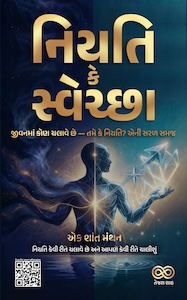
English or Gujarati. A printed copy in India by WhatsApp, or Amazon in twelve countries.
 By Tejash Shah · Amazon bestselling author of 10 books
Get your copy
In English and Gujarati
Printed copy in India
Ships across India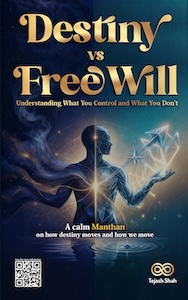
- 1Pay ₹464 by GPay to 9820562897
- 2Send your delivery address and edition (English or Gujarati) on WhatsApp to 7357575731
Amazon worldwide
ISBN 9798276558493In India, printed copies are ordered on WhatsApp (left).
Readers say
A book you read slowly
A quietly powerful read
“This book doesn’t lecture or preach. Through simple conversations, it slowly changes how you look at effort, destiny, and acceptance.”
Clarity without complexity
“The ideas are deep, but the language is simple. It helped me understand karma and freewill without confusion or heavy philosophy.”
Questions
Before you begin
Is this book about destiny or freewill, or does it take a side?
It does not take sides. It explores how destiny and freewill coexist: some things in life are given, others are shaped by our choices, and understanding the difference brings clarity.
Do I need a spiritual or philosophical background to read it?
Not at all. The book avoids heavy philosophy and jargon. It uses a simple conversation and everyday examples like rain, traffic, a fever and a job loss, so anyone can follow it.
Is this book religious?
No. It draws on Indian wisdom, including the Bhagavad Gita, the Upanishads, Osho and Vipassana, but it does not promote any religion or belief system. The focus is understanding life, not following doctrine.
How is karma explained: as reward and punishment?
As cause and effect, not reward or punishment. Destiny gives the situation, you respond with freewill, your response creates a result, and that result becomes your next destiny.
Why is the book written as a conversation?
Because real understanding often comes through dialogue, not instruction. Two friends talk over chai, one asking the questions most of us carry silently and one answering with patience and humour. It mirrors how we question life inside our own heads.
Does the book say everything is already decided?
No. It explains where destiny ends and freewill begins: destiny is what cannot be changed, and anything that can be changed is freewill. Confusing the two creates unnecessary suffering.