Preface
“Destiny brings us tools, people, and opportunities… and freewill decides how we use them.”
How the book began: a casual question from a friend on an ordinary day that refused to leave. What shapes our life, destiny or freewill?
Chapter guide
What each chapter covers, without giving the whole conversation away.
 By Tejash Shah · Amazon bestselling author of 10 books
Movement 1 · The beginning
“Destiny brings us tools, people, and opportunities… and freewill decides how we use them.”
How the book began: a casual question from a friend on an ordinary day that refused to leave. What shapes our life, destiny or freewill?
“The seeker is not important. The seeking is.”
Why the two friends have no names. They could be sages near a river or two friends at a tea stall. What they talk about is bigger than who they are.
“If destiny controls everything, should I just sleep all day and blame destiny when my life goes nowhere?”
Over chai, the friend asks the question as casually as ordering a samosa. Behind the joke is a real doubt most of us carry: am I living my life, or is life living me?
Movement 2 · Destiny
“Destiny is what life gives you. FreeWill is what you give back.”
Destiny is not magic or a puppeteer. It is the weather, the traffic, the family you are born into: the part of life that comes to you, not from you. It is the starting point, not the whole story.
Movement 3 · FreeWill
“Automatic doesn’t mean destiny. It means habit.”
The friend protests that his anger and laziness feel automatic, so they must be destiny. The Guide explains that habits are old choices repeated, and that freewill is a muscle that weakens when unused.
“Destiny brings the situation. FreeWill decides the direction.”
Starting from zero: rain outside is destiny; the umbrella, the dance or the chai is freewill. Then bigger examples, an illness and a hard decision at work, and how each response shapes what comes next.
Movement 4 · Karma
“If you created a habit, you can uncreate it.”
The chain reaction at the heart of the book: destiny gives the situation, you respond, the response creates a result, and that result becomes your new destiny.
“If something can be changed, it is freewill. Destiny is what cannot be changed.”
What if even my choices are written? The friend pushes back, and the Guide offers a simple test for telling destiny and freewill apart.
“Destiny gave illness. FreeWill shaped recovery.”
Five examples Indian parents would approve of: health, job loss, letting someone go, love and relationships, and the same 24 hours everyone receives.
““If it’s written, it will happen.” This sentence has destroyed more dreams than failure ever did.”
Destiny as the universal excuse: it protects the ego, avoids hard work and responsibility, softens pain, and is often taught wrongly from childhood.
Movement 5 · Together
“You can’t stop the event. But you can choose the experience.”
Destiny controls the outer world; freewill controls the inner world of thoughts, emotions, habits and reactions. Life becomes peaceful when the inner world grows stronger than the outer.
“Destiny gives the scene. FreeWill writes the story.”
Not enemies but partners. Destiny opens the door, freewill walks through it. And when destiny’s timing meets your readiness, people call it luck.
“Purushartha is greater than Prarabdha.”
Prarabdha, Purushartha and Karma; the Gita’s line on action and its fruits; the Upanishads’ freedom inside a boundary; and the old saying that God gives laddoos, but you must open your mouth.
“And that impossibility… is destiny.”
A seeker asks a saint whether he has freewill. Lift your right leg, says the saint. Now lift your left leg too. One of the clearest stories ever told on the subject.
Movement 6 · Closure
“You are not totally free. You are not totally bound. You are a meeting of both.”
Osho’s partial freedom, responsibility as the doorway to freedom, and the two prisoners who looked at the same locked door.
“Pain is destiny. Suffering is freewill.”
How ten days of silence taught the author to pause between sensation and reaction, and why in silence, the truth becomes loud.
“Destiny gives the moment. FreeWill gives the meaning.”
The friend takes his final exam over empty chai cups, passes with distinction, and leaves with one last joke about God’s toughest test.
Get your copy
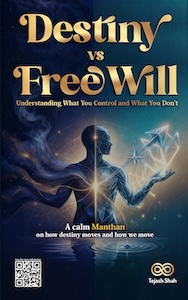
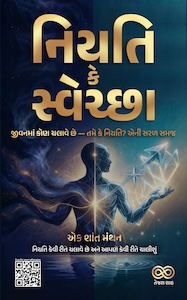
In India, printed copies are ordered on WhatsApp (left).